MongoDB Schema Design Best Practices for Node.js Applications
MongoDB schema design best practices for Node.js: embedding vs referencing, design patterns, Mongoose with TypeScript, indexes, validation and pagination.
Harsh Thummar
Read Article →Financial software has to be accurate, private and quick to use, or people stop using it. I build finance dashboards around one simple loop: log a transaction, let it update everything it affects, and review the bigger picture whenever you need to.
Based on HSFin, a live personal finance app I designed and built on my own with React, Node.js, Express and MongoDB. Bank integrations are planned, not implemented.
Salary, spending, subscriptions, cards and loan EMIs live in different apps and notes, so the overall picture is always out of date.
Without category budgets, people find out they overspent at the end of the month instead of while they can still adjust.
Loan EMIs and card payments without reminders lead to missed payments and avoidable fees.
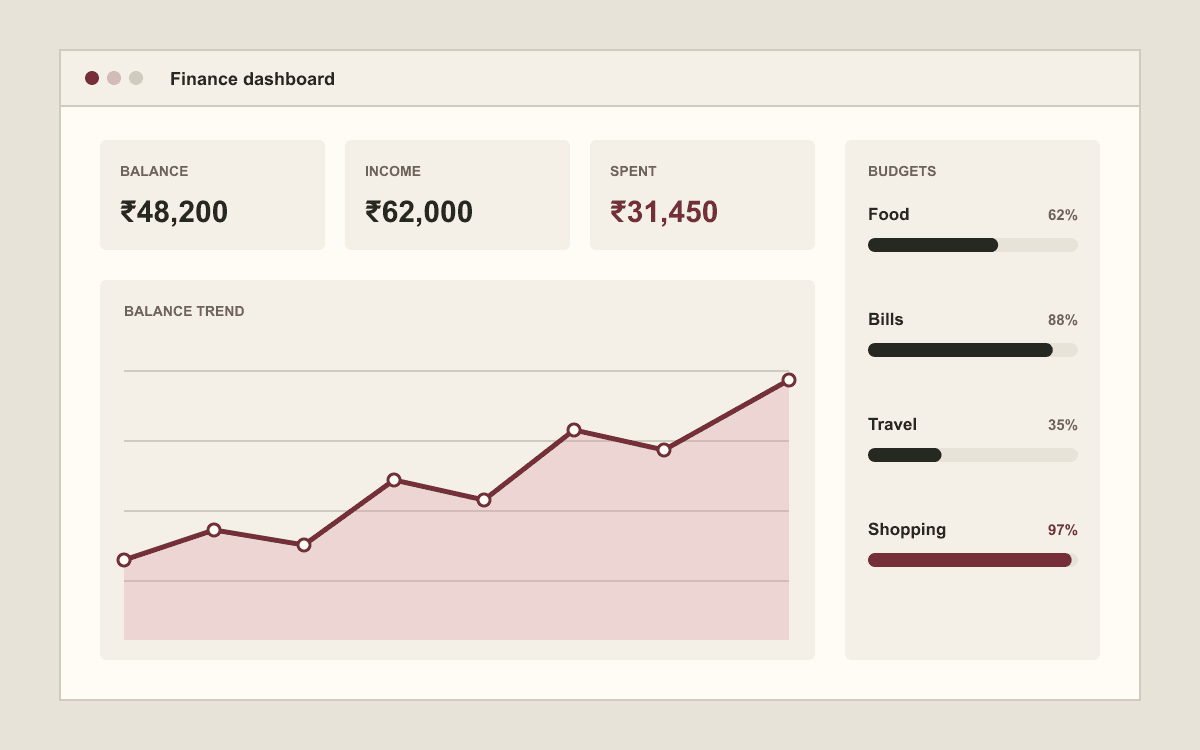
Balances, income against spending and upcoming bills on a single home screen.
Budget meters per category show how much has been used and warn as a limit gets close.
Category charts and month-over-month trends turn transaction lists into decisions.
This is the loop implemented in HSFin.
HSFin is a personal finance app for tracking expenses, loans and credit cards and seeing your financial health on one dashboard. I designed and built it on my own as a full-stack JavaScript app: a React frontend, a Node.js and Express REST API, and a MongoDB database, with every record scoped to the signed-in user. It is live at hsfin.vercel.app.
React / Node.js / Express / MongoDB / Tailwind CSS / Chart.js
Read the full HSFin case study →MongoDB schema design best practices for Node.js: embedding vs referencing, design patterns, Mongoose with TypeScript, indexes, validation and pagination.
Harsh Thummar
Read Article →Learn how to build a secure REST API using Node.js, Express, MongoDB, and JWT authentication with proper validation, authorization, error handling, and security practices.
Harsh Thummar
Read Article →Learn how to build a full-stack web application using React, Node.js, Express, and MongoDB, including frontend, REST API, database, authentication, and deployment.
Harsh Thummar
Read Article →Yes. HSFin is a live personal finance app for tracking expenses, loans, credit cards and budgets. I designed and built it on my own with React, Node.js, Express and MongoDB.
Bank connections require a third-party aggregation provider and its approval process. HSFin does not connect to banks today; that integration is planned. I can plan and build such an integration with a provider you choose.
Yes. Category budgets with progress meters, charts by category and month-over-month trends are all part of HSFin.
Yes. I design the data model around your accounts and categories, then build the views that show what matters at a glance.
In HSFin, passwords are hashed with bcrypt, sessions use JWT authentication, every route validates its input, and each database query is scoped to the signed-in user, so a request can only return that user's own records.