
HSFin
Personal Finance & Wealth Management Platform
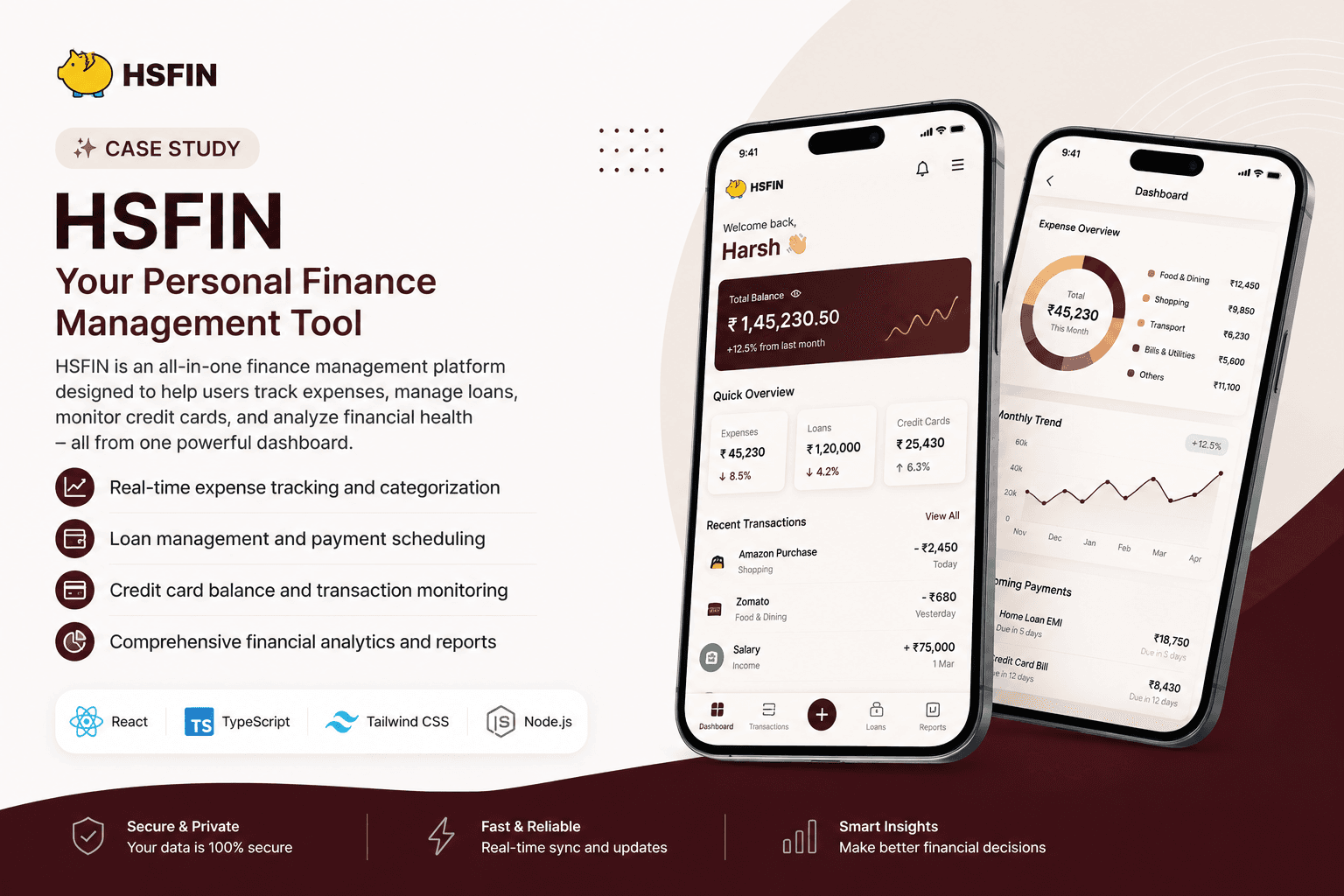
HSFin is a personal finance management and wealth tracking web application created to help individuals take full control of their money. Rather than juggling messy spreadsheets or complicated banking apps, HSFin provides a clean, unified dashboard to log transactions, set monthly budget limits, track recurring loan EMIs, and visualize spending habits over time.
Technologies & Tools Used
Personal finances become difficult to monitor without unified visibility
Managing personal finances requires tracking diverse cash flows: salary, freelance income, daily expenses, subscriptions, credit cards, and loan EMIs.
When spending data is scattered across multiple banking apps and manual notes, users lose sight of their monthly burn rate, leading to overspending and missed financial targets.
Key Challenges & Friction Points
Build a streamlined, secure personal finance platform that simplifies transaction logging, visualizes cash flow analytics, and provides proactive budgeting controls.
Product Architecture & Financial Flow
HSFin was built around clarity and simplicity: financial data should be effortless to log, easy to categorize, and intuitive to review at a glance.
HSFin System Workflow Pipeline
Key Platform Requirements Identified
User Experience & Wealth Dashboard
The UX focuses on turning intimidating financial numbers into clean visual charts, progress bars, and actionable summaries.
User Experience & Architecture (1 Unified Dashboard)
The unified dashboard serves as the command center, displaying net worth, monthly income vs. expenses, upcoming bills, and budget utilization at a glance.
Platform Structure & Modules
Transaction Management Hub
Enables instant logging of income and expenses with date filtering, category tagging, and search capabilities.
Budgeting & Threshold Engine
Allows users to define spending limits per category and visualizes budget consumption in real time.
Recurring Debits & Loan Tracker
Tracks active loans, EMIs, and recurring monthly subscriptions with calculated amortization timelines.
Financial Analytics & Reports
Generates visual reports, monthly spending comparisons, and savings rate calculations.
React.js + Node.js + MongoDB Architecture
Architecture System Pipeline
Frontend Layer
- ▸React.js with modular component architecture
- ▸Tailwind CSS for responsive layouts and theme styling
- ▸Chart.js / visual data rendering for expense breakdown graphs
- ▸React Router for smooth multi-page navigation
Backend & Data Layer
- ▸Node.js with Express framework powering RESTful API endpoints
- ▸MongoDB Atlas cloud database with Mongoose schemas for transactions and budgets
- ▸Bcrypt password hashing and JWT-based session security
- ▸CORS middleware and strict input validation layers
Key Engineering Challenges & Solutions
Displaying raw tables of numbers makes it hard for users to quickly understand their financial health.
Adding, editing, or deleting a transaction impacts total balances, category totals, and monthly budget limits simultaneously.
Financial records are sensitive and require strict privacy safeguards.
Core Solution Pillars
Centralized Financial Hub
Monitor all income, expenses, and savings goals in one secure dashboard.
Proactive Budget Management
Set category spending limits and receive visual warnings before overspending.
Visual Cash Flow Trends
Understand spending habits through clear charts and month-over-month reports.
Scalable MERN Architecture
Robust React, Node.js, and MongoDB stack engineered for speed and reliability.
Key Project Results
Final Outcome & Key Takeaway
HSFin transforms personal financial management from a stressful chore into an empowering digital experience. By combining a clean interface with a robust Node.js and MongoDB backend, the platform makes financial visibility and budgeting accessible to everyone.
HSFin delivers complete financial clarity through simple transaction logging, visual analytics, and proactive budget controls.
Technology Specification Matrix
Related Engineering & Architecture Guides
How to Build a Full-Stack App with React, Node.js & MongoDB
Complete architectural blueprint for building scalable, database-driven MERN applications.
How to Build a Secure REST API with Node.js & MongoDB
Industry-standard authentication, rate-limiting, and encrypted session security for financial data.
TypeScript with React and Node.js: Complete Guide
Build scalable financial calculations, type-safe API contracts, and robust state models.
Explore Other Software Engineering Case Studies
VettedPool — Recruitment & Job Portal Platform
VettedPool is a modern recruitment and job management web platform built with React.js and a robust Laravel MySQL backend. Designed to connect hiring teams with pre-screened, high-caliber candidates, the platform eliminates the chaos of scattered emails and unorganized resume files. By leveraging relational SQL architecture and 4 dedicated role-based dashboards, VettedPool creates an effortless hiring experience for candidates, recruiters, employers, and administrators.
NutriLeft — Nutritional Intelligence & Food Guide Platform
NutriLeft is a modern nutritional intelligence and dietary guide platform built with a high-performance Next.js frontend and a scalable Laravel MySQL backend. Engineered to help health-conscious individuals, athletes, and dietitians understand the exact nutritional profile of everyday foods, NutriLeft provides side-by-side food comparisons, real-time gram-based portion scaling, and a smart meal calculator powered by a structured SQL database containing over 20 macro and micronutrient parameters per item.