
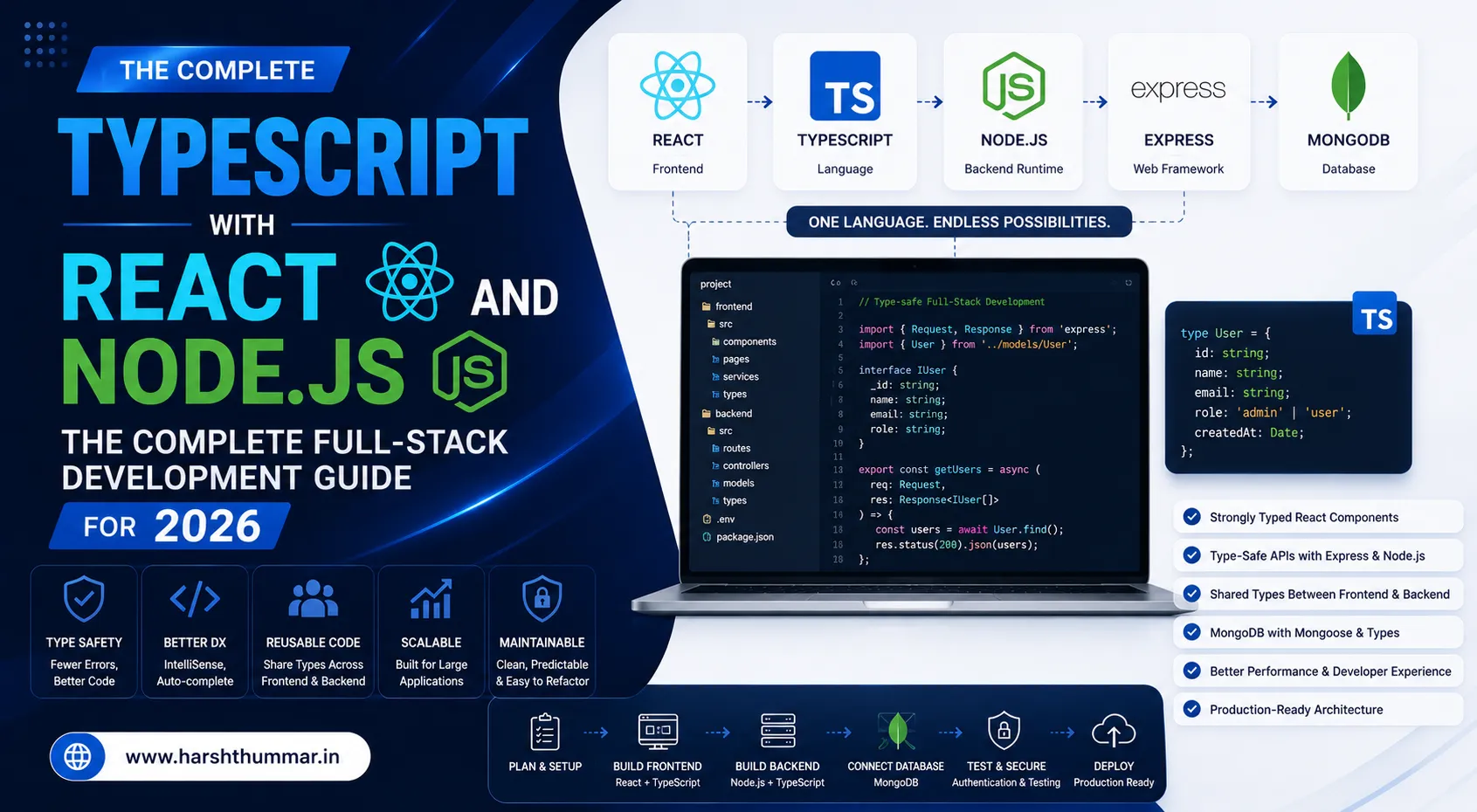
TypeScript with React and Node.js: The Complete Full-Stack Development Guide for 2026
JavaScript remains one of the most important technologies for modern web development, but large applications can become difficult to maintain when the codebase grows.
This is where TypeScript becomes useful.
TypeScript adds static typing and improved developer tooling on top of JavaScript. When combined with React on the frontend and Node.js on the backend, it allows developers to use one strongly typed language across the entire application.
In this guide, we will explore how to build a modern full-stack application using React, TypeScript, Node.js, Express, and MongoDB.
What Is TypeScript?
TypeScript is a programming language built on top of JavaScript.
The biggest difference is that TypeScript allows developers to define types for variables, objects, function parameters, API responses, and application data.
For example, instead of working with completely unknown data, you can define exactly what your application expects.
This can make large applications easier to understand and maintain.
Why Use TypeScript for Full-Stack Development?
Using TypeScript across frontend and backend provides several advantages.
- Better Code Quality : Types can help developers identify incorrect values during development.
- Better Developer Experience : Modern editors provide better autocomplete, navigation, and error detection.
- Easier Refactoring : When an application grows, type information can make changes safer.
- Shared Types : Frontend and backend applications can share interfaces and data models.
- Better Team Collaboration : Types make it easier for developers to understand how functions and APIs are expected to work.
React + TypeScript
React works very well with TypeScript.
You can define types for:
- Component props
- State
- Events
- API responses
- Forms
- Reusable components
- Custom hooks
For example, a reusable user component might expect:
- name
- role
- avatar
Instead of guessing what data a component receives, TypeScript can clearly define the expected structure.
Node.js + TypeScript
TypeScript can also be used on the backend.
A typical backend architecture can be:
React → Node.js → Express → MongoDBWith TypeScript:
React + TypeScript → Node.js + TypeScript → MongoDBThis allows the development team to use a consistent programming language and type system across the application.
Building a Full-Stack TypeScript Application
A practical project structure could contain:
Frontend
- React
- TypeScript
- React Router or Next.js
- API client
- Form validation
- Reusable UI components
Backend
- Node.js
- Express
- TypeScript
- Authentication
- API routes
- Validation
- Error handling
Database
- MongoDB
- Mongoose
- Indexed queries
- Data validation
Creating Type-Safe APIs
One of the biggest advantages of TypeScript is defining the structure of API data.
For example, a user API might return:
- ID
- Name
- Role
- Created date
The frontend can use a matching type so developers know exactly what data is available.
This reduces many common mistakes when frontend and backend developers work independently.
TypeScript Authentication
Authentication is another area where TypeScript can improve maintainability.
A typical authentication system includes:
Login → Validate User → Generate Token/Session → Store Securely → Access Protected APITypeScript can help define:
- User objects
- Authentication responses
- JWT payloads
- Request objects
- API errors
- Role permissions
This becomes especially useful when implementing role-based access control.
TypeScript with MongoDB
MongoDB is flexible, but application code still needs a clear understanding of data structures.
TypeScript interfaces and database schemas can work together to make application data easier to manage.
For example, a product could contain:
- Name
- Price
- Category
- Description
- Stock
- Created date
Defining these structures clearly can reduce unexpected data-handling errors.
TypeScript vs JavaScript
JavaScript — Best for:
- Small projects
- Quick prototypes
- Beginners
- Simple scripts
TypeScript — Best for:
- Large applications
- Team projects
- Long-term products
- Complex APIs
- Scalable frontend applications
- Large Node.js backends
TypeScript does not replace JavaScript. Instead, it provides additional development capabilities while compiling to JavaScript.
TypeScript Best Practices for 2026
When building a modern application, follow practices such as:
- Enable strict type checking
- Avoid unnecessary any
- Create reusable types
- Keep API types consistent
- Validate external data
- Use clear interfaces and type aliases
- Keep components small
- Separate business logic from UI
- Use environment variables for secrets
- Add automated testing
TypeScript is most useful when it is used consistently rather than added only to a few files.
Should You Learn TypeScript in 2026?
If you already know JavaScript, learning TypeScript is a natural next step.
It becomes even more useful when working with React, Next.js, Node.js, and modern full-stack applications.
The combination gives developers a powerful path toward building larger and more maintainable applications.
Conclusion
Modern full-stack development is increasingly focused on maintainability, performance, scalability, and developer productivity.
React provides the UI layer, Node.js provides the backend runtime, Express can handle APIs, MongoDB can manage application data, and TypeScript adds a strong type system across the stack.
For JavaScript developers looking to build production-ready applications in 2026, TypeScript is an excellent technology to add to the development toolkit.
Related Case Studies & Architecture Guides
See how full-stack TypeScript and JavaScript architectures power real-world platforms:
- NutriLeft Case Study : Next.js & TypeScript platform with real-time mathematical nutrient calculation engines and Laravel MySQL backend.
- HSFin Case Study : Production finance platform with React, Node.js, Express, and MongoDB.
- VettedPool Case Study : Decoupled 4-role recruitment web platform built with React and Laravel SQL.
- How to Build a Full-Stack App with React, Node.js & MongoDB : Step-by-step full-stack architecture.
Frequently Asked Questions
Is TypeScript better than JavaScript?
Neither is universally better. TypeScript is especially useful for larger and more complex applications, while JavaScript remains excellent for smaller projects and quick development.
Can I use TypeScript with React?
Yes. TypeScript works directly with React and can provide types for components, props, state, events, hooks, and API data.
Can Node.js use TypeScript?
Yes. TypeScript can be used to build Node.js backend applications and APIs.
Is TypeScript difficult to learn?
If you already know JavaScript, TypeScript is relatively straightforward because it extends JavaScript with additional type-system features.
Should full-stack developers learn TypeScript?
Yes. TypeScript is particularly useful for developers building and maintaining larger React, Next.js, Node.js, and full-stack applications.
How to Build an AI Agent with Next.js 16 and React in 2026
How to Build an AI-Powered Web Application with Next.js, Node.js, and MongoDB in 2026
Related Articles & Guides
React vs Next.js: Which Should You Choose for Your Next Web Project?
React vs Next.js explained. Learn the key differences, advantages, SEO considerations, performance, routing, rendering, and when to use each technology.
How to Build a Full-Stack Web Application with React, Node.js, Express, and MongoDB
Learn how to build a full-stack web application using React, Node.js, Express, and MongoDB, including frontend, REST API, database, authentication, and deployment.
Next.js 16 Authentication: Secure Login, JWT, Sessions and Protected Routes
Learn how to implement secure authentication in Next.js 16 with login, sessions, protected routes, authorization, password hashing, JWT concepts, and best practices.